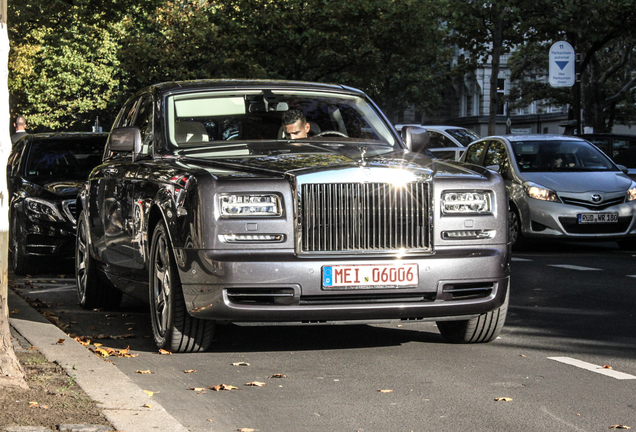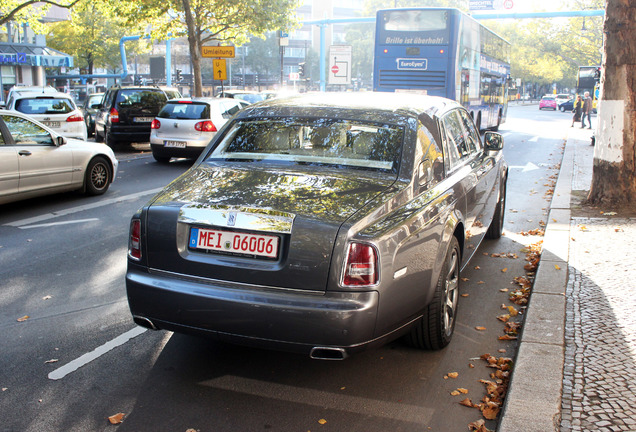
In their prime years, Rolls-Royce and Bentley introduced a model so beloved that it remained in production for almost three decades with only minimal changes. We are talking about the legendary Silver Shadow, here in its Bentley Continental Convertible form.
The development of the legendary Bentley Continental Convertible over nearly three decades is one of the most fascinating stories in British automotive history. It tells the tale of how a design icon survived the technological revolution of the post war era and ultimately became the spearhead of a brand many had already written off.
During the 1950s, the company still built its cars using traditional body on frame construction. The factory supplied the rolling chassis of the Rolls-Royce Silver Cloud and the nearly identical Bentley S Type, while independent coachbuilders such as H.J. Mulliner, Park Ward and James Young crafted bespoke bodies to customer specifications. These chassis gave rise to legendary special models such as the Bentley S1, S2 and S3 Continental, often built as spectacular Flying Spurs or elegant two door convertibles. They were exceptionally expensive, immensely luxurious and, thanks to the 6.25 litre V8 introduced in 1959, remarkably fast. By the mid 1960s, however, this heavy body on frame construction had become technically outdated.
In the autumn of 1965, the company revolutionised its manufacturing process with the introduction of the Rolls-Royce Silver Shadow and Bentley T1, the first models to feature unitary construction. The separate chassis disappeared. The new cars were lower, more modern, offered improved interior space and featured an innovative hydropneumatic self levelling suspension system licensed from Citroën. Since it was no longer possible to supply bare chassis to independent coachbuilders, it seemed that the era of exclusive coachbuilt bodies had come to an end. Yet the wealthy clientele still demanded an open top version.
To satisfy this demand, the factory commissioned its in house coachbuilding division, Mulliner Park Ward, to develop two door coupé and convertible variants based on the new monocoque structure. Chief designer John Blatchley created a timeless silhouette distinguished by its elegant, gently curved rear haunches, a feature that became known as the Coke bottle line.
Introduced in 1967, the Bentley T1 Drophead Coupé represented the open version of the T1, and its production was a logistical masterpiece. The unfinished bodies were transported from the main factory to Mulliner Park Ward in London, where they were cut open, reinforced, lavishly finished by hand over several months, and then returned for final assembly. As the saloons evolved, these rare convertibles temporarily adopted the more modern technology of the Bentley T2 Drophead Coupé in 1977, including rack and pinion steering and an improved air conditioning system.
In March 1971, the two door models received a dedicated name inspired by the world famous coastal road along the Côte d'Azur, giving birth to the Bentley Corniche Convertible. Technically, the car impressed with an enlarged 6.75 litre V8 engine. During this period, however, Bentley suffered from a severe image problem. Many perceived its cars as little more than Rolls-Royces with a different grille. Buyers overwhelmingly chose the Rolls-Royce equivalent, and over a thirteen year production run, only 77 examples of the Bentley Corniche Convertible were built, making these cars highly sought after collector's items today.
In the early 1980s, defence contractor Vickers acquired the luxury marque and decided to reposition Bentley as a performance oriented brand. One of its most brilliant moves came in 1984 with the revival of one of the most evocative names in Bentley history, transforming the Corniche into the Bentley Continental Convertible.
Although the basic shape introduced in 1967 remained intact, the car underwent continuous and significant modernisation. In 1987, Bosch K Jetronic electronic fuel injection was introduced. At the beginning of the 1990s, the old three speed automatic transmission was replaced by a modern four speed GM automatic gearbox. ABS, airbags and a fully electric convertible top with a real glass rear window also found their way into the car.
The ultimate expression of the model arrived during its final years. According to factory records, only eight examples of the Bentley Continental Turbo were built between 1992 and 1995. Equipped with the mighty turbocharged engine from the Turbo R, these rare cars produced well over 300 horsepower and endowed the ageing body style with astonishing performance.
The strategy proved successful. Under the Continental name, sales figures increased dramatically compared with the Corniche era, and by the end of production in 1995, a total of 421 examples had left the factory.
In 1995, after exactly twenty eight years, the final convertible of this lineage rolled off the production line. It was the last car produced by the company whose structural foundation and design DNA could be traced directly back to the 1965 Silver Shadow. Later that same year, the icon was succeeded by the muscular and completely redesigned Bentley Azure, bringing the graceful flowing lines of the 1960s to a definitive close.
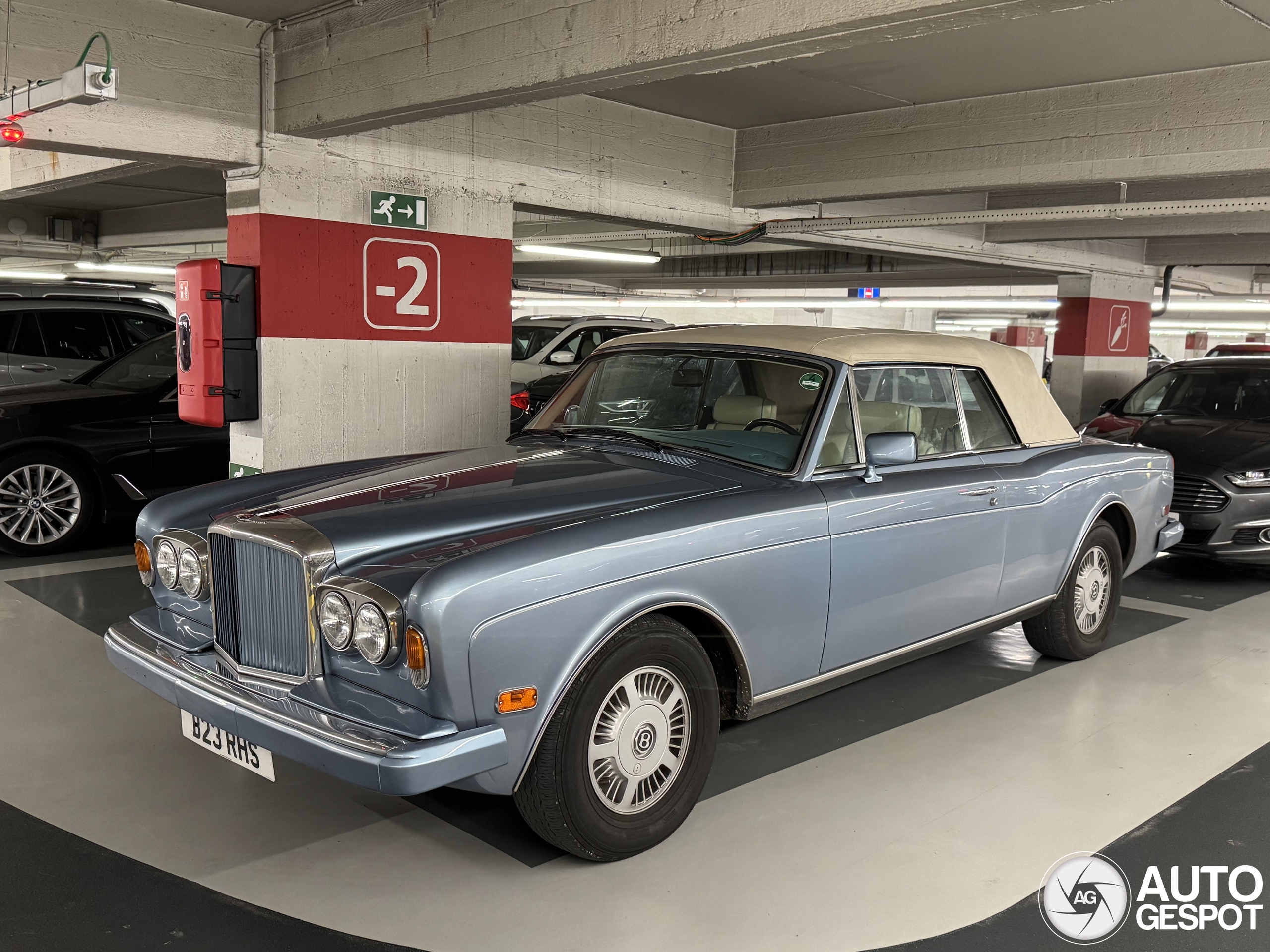
As a devoted Rolls-Royce Silver Shadow enthusiast, I simply had to highlight this wonderful example of the Bentley Continental Convertible with a short feature of its own. Then, as now, owners could personalise their cars with countless subtle details to make them even more distinguished.
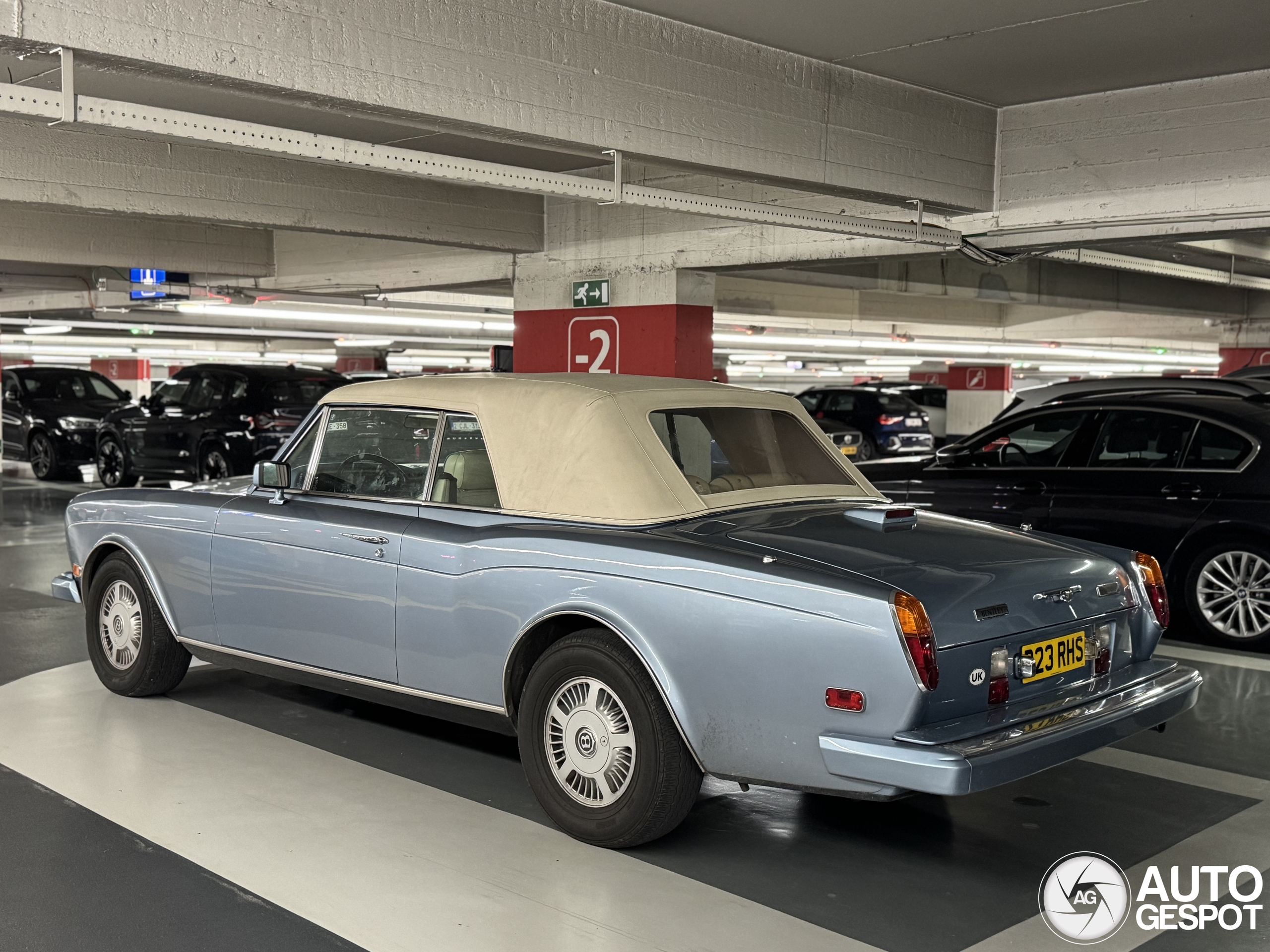
This particular example, originally from England and spotted in an underground car park in Antwerp, was specified without the slightest regard for cost. The front and rear bumpers, normally finished in a combination of rubber and chrome, had been painted in body colour, lending the car a far more refined and elegant appearance. The front grille was also finished in the same beautiful light blue metallic paintwork, perfectly complemented by a beige convertible top.
It is one of the most iconic shapes ever created by Rolls-Royce and Bentley, presented here in an absolutely magnificent specification.
 Click on the photo for more photo's of this spot!